Your first Dubai holiday home is earning, and the question has changed. It is no longer whether short-term rental works. It is how to grow from one unit to three, then five, without the work growing faster than the income. This guide is the scaling playbook: the worked dirham math, the compliance ladder that multiplies with every unit, what breaks first as you grow, and the exact point where handing the portfolio over beats running it yourself.
We run nine Superhost-rated Dubai listings ourselves, so every stage in this guide is one we have operated through, not one we read about.
Scaling Is a Different Business, Not a Bigger One
One unit is a side project. Three units is a part-time job. Five units is a business with staff, systems and a calendar that never sleeps. The mistake most owners make is treating unit three like unit one with a bigger spreadsheet. The work does not scale in a straight line. It jumps.
Each unit adds its own permit, its own guest messages, its own cleaning turns, its own pricing decisions and its own Tourism Dirham filing. The income stacks. So does the administration. The owners who scale well plan for the jumps before they buy the next unit.
The three stages of a Dubai portfolio
- Stage 1, one unit: Prove the model. Learn the nightly rate your area actually supports, the occupancy your listing actually holds, and the hours you actually spend. One unit teaches you the real numbers. Do not buy unit two on a forecast.
- Stage 2, two to three units: Systematize or stall. This is where cleaning schedules, linen rotation and message templates stop being nice to have. Owners who reach three units without systems spend their evenings answering the same five guest questions three times.
- Stage 3, four to five units and beyond: Decide who runs it. At this size the portfolio needs either a hire or a manager. The individual ceiling sits at eight units, so the decision is not whether to hand over, it is when.
The ceiling you plan around
An individual in Dubai can run up to eight holiday homes under the individual track. That number is commonly cited across operator and setup guides, and it is the ceiling to plan around, not a target to chase. Eight units run properly is a serious business. Eight units run badly is eight sets of fines, eight guest chats and eight calendars to keep straight.
Beyond eight, you need the company track, with a trade licence and an operator setup. That is a different decision with different costs, and it is the fork this guide covers in the compliance section below.
The Worked Math: One Unit vs Three vs Five
Every number below is a market benchmark, not a promise and not our own figures. The nightly rate and occupancy come from published market benchmarks for the areas named. Your unit will differ. The method is what matters: gross, minus platform fee, minus management fee, minus Tourism Dirham, minus permit. What is left is the owner net before cleaning and utilities.
| Portfolio | Gross booking revenue | Owner net before cleaning and utilities |
|---|---|---|
| 1 unit (1-bed benchmark) | AED 111,281 | AED 74,269 |
| 3 units (1-bed benchmark) | AED 333,844 | AED 222,808 |
| 5 units (1-bed benchmark) | AED 556,406 | AED 371,347 |

| Cost line | Per unit, per year | What it covers |
|---|---|---|
| Airbnb host fee (15.5% of gross) | AED 17,249 | Platform fee, deducted before payout |
| Management fee (15% of gross) | AED 16,692 | All-inclusive management, zero markups |
| Tourism Dirham (270 nights x AED 10) | AED 2,701 | Collected from guests, remitted monthly |
| DET unit permit (1-bed) | AED 370 | Annual permit, charged per unit |
| Registration (one-time, not per unit) | Around AED 1,520 | One-time operator registration |
The 1-bed benchmark behind the table is a published market figure for a JVC one-bedroom: a nightly rate near AED 412 at around 74% occupancy, or about 270 occupied nights a year. The management fee in the table is the 15% base inside the 15 to 24 percent all-inclusive band, so the net is the best case on fees; at the top of the band the same unit pays about AED 26,707 in management fees instead of AED 16,692. Figures are rounded to the nearest dirham.
A two-bedroom tells the same story at a higher level. A published benchmark for a managed two-bedroom puts the nightly rate near AED 902 at around 71% occupancy. That is roughly AED 233,753 gross a year and roughly AED 156,606 owner net before cleaning and utilities, using the same 15.5% platform fee, 15% management fee, Tourism Dirham at the Standard rate for two bedrooms and the two-bedroom permit. The pattern holds: the portfolio math is the per-unit math, multiplied, with the permit ladder ticking up per unit. Pricing is what moves the gross line most: how to maximize Airbnb income in Dubai.
What the numbers leave out
- Cleaning and linen: Every turnover has a cleaning cost and a linen cost. At one unit it is a line item. At five units it is a weekly operation with its own supplier and its own failure points.
- Utilities and service charges: DEWA, internet and building service charges run whether the unit is booked or empty. Empty nights cost you twice: no income and the same fixed bills.
- Furnishing and refresh: Furniture wears faster under short stays than under a long tenant. Budget a refresh cycle, not a one-off furnishing spend.
- Vacancy and seasonality: The benchmarks above use annual averages. Summer occupancy runs lower. Price for the year, not for the best month.
If the admin load is what worries you, compare the portfolio against a fixed monthly offer first: guaranteed rent in Dubai.
What Breaks First at 3, 5 and 10 Units
We run nine listings as a Superhost operation. Here is what actually breaks, in the order it breaks, and what we did about it. No case study, no invented numbers. Just the work.
Cleaning and linen rotation
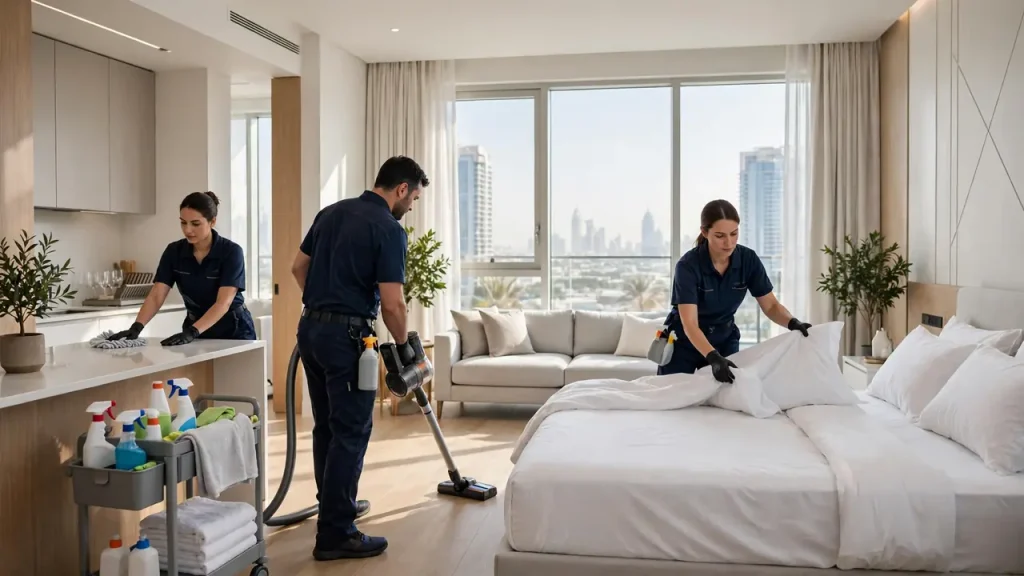
At one unit, one cleaner and one linen set works. At three units with same-day turnovers, it does not. The failure looks like this: a guest checks out at eleven, the next checks in at three, and the cleaner is at the other unit. The fix is a linen rotation with spares per unit and a cleaner booked by the turnover calendar, not by phone call. At five units, cleaning is a rota, not a favour.
Messaging volume and guest registration
One unit means a handful of messages a day. Five units means a constant stream, and every guest still has to be registered on arrival. The failure is a message answered late and a registration filed late on the same evening. The fix is message templates for the five questions every guest asks, and registration done at check-in, never batched for later. This is the step most self-managing owners underestimate, because it never shows up in the income spreadsheet.
Screening is the other half of the messaging load: how to screen short-term rental guests in Dubai.
Pricing and calendar discipline
One unit lets you set a rate and check it weekly. Five units punish a stale rate five times over. A rate left high through a soft week costs five empty nights, not one. The fix is a weekly pricing review across the whole portfolio and minimum-stay rules that flex with the season. The owners who scale fastest are the ones who treat pricing as a weekly habit, not a one-off setup task.
The Dubai Compliance Ladder, Per Unit
Compliance is the one cost that multiplies exactly with your portfolio. There is no bulk discount on permits. Every unit carries its own.
| Unit size | Annual unit permit | Tourism Dirham per night |
|---|---|---|
| 1 bedroom | AED 370 | AED 10 Standard, AED 15 Deluxe |
| 2 bedrooms | AED 670 | AED 10 Standard, AED 15 Deluxe |
| 3 bedrooms | AED 970 | AED 10 Standard, AED 15 Deluxe |
| 4 bedrooms or more | AED 1,270 | AED 10 Standard, AED 15 Deluxe |
Tourism Dirham is charged per occupied bedroom, per night, so a two-bedroom on a busy month remits roughly twice what a one-bedroom does at the same occupancy. Registration sits around AED 1,520 as a one-time operator registration, not a per-unit fee. The permit is the per-unit line, and it is what your portfolio math must carry for every unit you add. Insurance stays mandatory on every unit, and guest registration applies to every stay, on every unit, every time.
Apply through the official DET holiday home permit page. For the full fee stack behind this ladder, see the holiday home license cost breakdown. The deep version of this section lives in our guide on how to start a holiday home business in Dubai.
When you cross from owner to operator
There is a second fork most scaling guides skip. Running your own units is one track. Managing other owners’ homes is another, and it needs an operator setup with a trade licence and its own DET registration. The moment you start charging someone else to run their unit, you have crossed it. Plan the crossing deliberately. An owner who drifts into managing a friend’s unit without the operator setup is running an unlicensed business on top of a licensed portfolio.
This is also where the eight-unit ceiling bites in a different way. If your own portfolio is approaching it, the next unit is either a company-track decision or a handover decision, not just another listing.
Scale or Hand Over: The Decision Table
Read the table honestly. If you have a full-time job and a family, three units self-managed is already a second job. The decision is not about ambition. It is about hours, and hours are the one cost that never shows up in the income table.
| Portfolio size | Your week, self-managed | Best route |
|---|---|---|
| 1 unit | Around 5 to 8 hours | Self-manage and learn |
| 3 units | Around 15 to 20 hours | Systems plus a co-host, or hand over |
| 5 units or more | Around 30 hours or more | Full management |
Hours are our operator estimates from running nine listings, not a surveyed average. They cover messaging, guest registration, pricing checks, cleaning coordination and owner admin. They do not cover furnishing, repairs or the weeks when two turnovers land on the same day.
If you have not started yet, the launch guide is where you begin: how to start an Airbnb business in Dubai. See what full management actually covers in our short-term property management company guide.

The staged sequence
- Prove one unit: Hold it for a full season, low and high, before you buy the next. One good winter month is not a business case.
- Systematize at two: Templates, linen rotation, cleaner rota, pricing review. Build the machine before unit three, not after it breaks.
- Decide at three: Self-manage with systems, bring in a co-host, or hand the portfolio over. Do not drift. Drifting is how owners end up running four units badly instead of three units well.
- Hand over or hire at five: At five units the portfolio needs a named person whose job it is, every day. That person is either your hire or your manager. There is no third option that works.
Direct bookings become a real portfolio lever at this size: get more direct bookings in Dubai.
The Five Mistakes That Stall Portfolios
- Buying unit two on unit one’s best month: A strong winter month is not an annual average. Scale on twelve months of numbers, not on one good statement.
- Pricing every unit the same: Different areas, different buildings, different rates. A portfolio priced from one spreadsheet leaves money on the table in three places at once.
- Treating compliance as a one-off: Permits renew per unit, per year. Guest registration happens per stay. The owners who get fined are usually the ones who set compliance up once and forgot it.
- Hiring help too late: The cleaner, the co-host or the manager should arrive before the portfolio breaks, not after the first bad review. A single one-star review on a new listing costs more than a month of help.
- Keeping the admin to save the fee: A 15% management fee looks expensive until you price your own hours. At five units, the fee buys back a full-time job. That is the comparison that matters.
Why Owners Hand the Portfolio to StayBetterDXB
We run nine Superhost-rated listings ourselves, at a 4.99 rating across 81 reviews, so we manage portfolios the way we run our own: pricing reviewed weekly, guests registered at check-in, cleaning on a rota, reporting you can read. Our fee is 15% at the base, 15 to 24 percent all-inclusive, with zero markups, so the percentage you see is the percentage you pay. No lock-in that surrenders your units for years, no separate bills for the things a portfolio actually needs.
You keep the upside of every strong season, and you get your evenings back. That is the trade a portfolio owner is actually buying: not a service, but the hours to buy the next unit while the current ones run properly.
See the reviews behind that rating on our Superhost profile.
Send us your current unit count and your target, and we will show you the worked math for your portfolio, free. The next unit is only a good idea when the numbers say so, and the numbers take ten minutes to check.
How many Airbnb units can one person run in Dubai?
An individual can run up to eight holiday homes under the individual track, a ceiling commonly cited across operator and setup guides. Beyond eight you need the company track, with a trade licence and an operator setup.
How much does it cost to add a unit to a Dubai Airbnb portfolio?
Every unit carries its own annual permit by bedrooms (370, 670, 970 or 1,270 dirhams), Tourism Dirham per occupied bedroom per night, and its share of cleaning, utilities and management. Registration of around 1,520 dirhams is a one-time operator cost, not a per-unit fee.
Is scaling an Airbnb business in Dubai profitable?
It depends on the nightly rate, the occupancy and the costs on each unit. The worked math in this guide uses published market benchmarks to show the method; scale on twelve months of your own numbers, not on one good season.
When should I hand my Dubai Airbnb portfolio to a manager?
When the owner hours pass around 15 to 20 a week at three units, or around 30 a week at five units, or when messaging, registration or cleaning starts slipping. The fee buys back the hours.
Can I manage other people’s holiday homes in Dubai?
Only under the operator track, with a trade licence and DET operator registration. Managing someone else’s unit without that setup is an unlicensed business, even if your own units are fully permitted.
What breaks first when scaling an Airbnb portfolio?
Cleaning and linen rotation first, then messaging volume and guest registration, then pricing discipline. Each one breaks at a different unit count, and each one has a system fix.
Should I buy more units or improve the ones I have?
Improve first. Fix pricing, reviews and occupancy on the units you own, then buy the next unit only after a full season of proven numbers. A portfolio of three strong units beats five average ones.