Starting a holiday home business in Dubai is a licensing project before it is anything else. Get the legal setup right and everything after it (listings, guests, revenue) runs on rails; get it wrong and you pay for the same mistake every month. This guide walks the legal setup in the order the regulator actually processes it.
This is written from the operator side of the desk. The consultants ranking for this keyword sell company formation; StayBetterDXB runs live Dubai holiday homes every day, so what follows is the permit, inspection, guest-registration and Tourism Dirham reality our team operates inside, not the paperwork version.

What a Holiday Home Business Actually Is in Dubai Law
In Dubai, a holiday home business is a licensed tourism activity, not a casual rental arrangement. The Dubai Department of Economy and Tourism (DET) regulates furnished residential units offered for short stays: whole units only, no room rentals. A sale-and-purchase agreement that prohibits short-term letting blocks the permit outright, so check the clause before you spend anything.
- The permit sits on the unit, not on you: Ten units means ten permits, each with its own number and its own renewal cycle.
- You cannot advertise before you are permitted: The permit number goes on the listing before it goes live. Unpermitted listings are visible to the regulator from day one.
The shortcut most articles sell: just list first, license later. Unlicensed operation exposes the operator to fines and listing removal, and listings are public, so there is little practical concealment. The permit is a precondition for the first booking.
The Two Legal Tracks: Individual Host or Licensed Operator
There are two legal tracks into the holiday home business, and you must pick the right one before you spend on furnishing. Pick the wrong track and you rebuild permits and contracts at the exact moment you try to grow.
| Track | Who it fits | The catch |
|---|---|---|
| Individual host | You own or legally occupy the unit(s) you will let; no company, no trade licence | Commonly cited ceiling of around 8 units under one individual; you cannot take on units belonging to other owners |
| Licensed operator | You run units for other owners, or past the individual ceiling | Requires a company: trade licence with the Vacation Homes Rental activity, then registration as a Holiday Home Operator with DET; still a permit for every unit |
If the plan is a management business (other people’s apartments, a revenue share), you are on the operator track from day one. Starting on the individual track and hoping to migrate later means rebuilding permits and contracts mid-growth. A management letter documents the operator-to-owner relationship for every third-party unit, and permit dates must match the letter’s validity.
One visa note: the individual track grants no visa quota; the operator track with a trade licence can sponsor investor, partner or employee visas under the standard quota system. Non-resident investors use the company track for banking access and residency.
What You Need in Hand Before You Apply
Incomplete applications are what take months. Assemble these documents before you touch the portal:
- Proof of your right to the unit: Title deed or a Dubai Land Department sale and purchase agreement.
- Written landlord authorisation if you are not the owner: A tenant or management company cannot short-let someone’s property on a handshake. This is the single most common blocker.
- Building NOC: The developer, owners association or building management may need to confirm short-term letting is allowed. Plenty of towers say no; get this answer before you sign a head-lease or spend a dirham on furnishing.
- Identity documents: Passport and Emirates ID for individuals; trade licence and authorised signatory documents for companies.
- A recent utility bill: Usually DEWA, in the correct name.
- Insurance: A policy from a UAE-licensed insurer covering short-term-rental use, including guest liability. Ordinary home contents cover usually does not extend to paying guests.
- Photographs of the unit: These feed the Standard or Deluxe classification.
The insurance requirement is a full topic in its own right: our guide to holiday home insurance in Dubai breaks down what the policy must cover.
holiday home insurance in Dubai

The Step-by-Step DET Setup Process
Here is the legal setup in the order the regulator actually processes it:
- Register on the DET holiday homes system: Create your account as an individual or operator and register as a holiday home operator. Pay the one-time operator registration fee (around AED 1,520; confirm the current figure on the official DET holiday home portal before you pay).
- Add each unit individually: Enter the property information and upload your documents. One permit per unit, each registered and classified on its own; growth is a recurring admin task, not a one-off.
- Self-classify as Standard or Deluxe: Choose the tier that matches the quality of your furnishing and amenities; it sets your Tourism Dirham rate and what you may advertise.
- Pass the property inspection: DET checks the unit against the classification standard. The inspection fee is in the low hundreds; confirm the current figure on the portal.
- Pay the annual unit permit fee: Around AED 370, 670 or 970 for 1, 2 or 3-bedroom units. Renewed every year per unit.
- Display your permit: Print the official permit QR code and display it visibly inside the property; displaying the permit in the unit is required.
- List only after approval: Add your DET-issued permit number to every listing. Only then is the unit ready for its first booking.
Timeline expectations: with complete documents, operator registration is typically measured in working days and unit permits follow shortly after; the full company route (formation plus registration plus permits) realistically runs from a few working days to around two weeks. The honest variable is document completeness, not the regulator.
What the Legal Setup Actually Costs
The cost summary only; the line-by-line tables live elsewhere.
| Cost line | What to budget | Notes |
|---|---|---|
| DET operator registration | Around AED 1,520 one time | Per operator account |
| Annual unit permit | AED 370, 670 or 970 by bedroom count | Per unit, renewed yearly |
| Property inspection | In the low hundreds | Confirm the current figure on the DET portal |
| Tourism Dirham | AED 10 Standard / 15 Deluxe per occupied bedroom per night | Collected from guests, remitted monthly; not an operator cost |
| Company setup (operator track only) | Trade licence plus annual renewal | For the management-company track, not individual hosts |
| Insurance | Comprehensive policy with guest-liability cover | Mandatory; operating without it carries its own fine |
For the full fee schedule, document checklist and worked cost exa
holiday home license cost in Dubai.
The Classification Decision: Standard or Deluxe
You self-classify during the permit application; the tier must match what the unit actually delivers.
- What decides it: The quality of the furnishing and the amenities you provide, backed by the photographs you upload.
- What it controls: Your Tourism Dirham rate (Standard vs Deluxe) and what you may claim on the listing.
- The risk of overstating: The classification you register determines what you can advertise, so overstating it creates a compliance problem as well as a review problem. Inspectors visit, and a unit that fails inspection is a unit that stops earning.
- Long stays: The Tourism Dirham on long continuous stays is typically capped at an initial run of nights rather than forever; confirm the current cap on the portal.
Tourism Dirham: The Government Fee You Collect
This is the most misunderstood line in the business.
- Per occupied bedroom per night: AED 10 for Standard, AED 15 for Deluxe. Per bedroom, not per guest, not per booking.
- You collect it, you remit it: Monthly, on the regulator’s cycle. It is not an operator cost, but it is a cash-flow item you must not spend.
- Pricing decision: Bake it into your nightly rate or add it at checkout, but stay consistent across every channel; mismatches between your direct rate and your OTA rate are a guest-complaint machine.
- VAT is different: VAT at 5% applies once annual taxable turnover passes AED 375,000. The Tourism Dirham is a guest charge remitted to DET; treating one as the other is a common bookkeeping error.
Inspections: What DET Checks and How to Pass
Registration is not just paperwork; the unit is classified, and the classification carries expectations.
- Life-safety provision: Smoke detection, fire extinguisher, emergency information for guests, a first-aid kit.
- Furnished to the claimed standard: Clean, genuinely fit for paying guests, working utilities on every turnover.
- QR code displayed: The official permit code visible inside the property, verifiable by inspectors and guests.
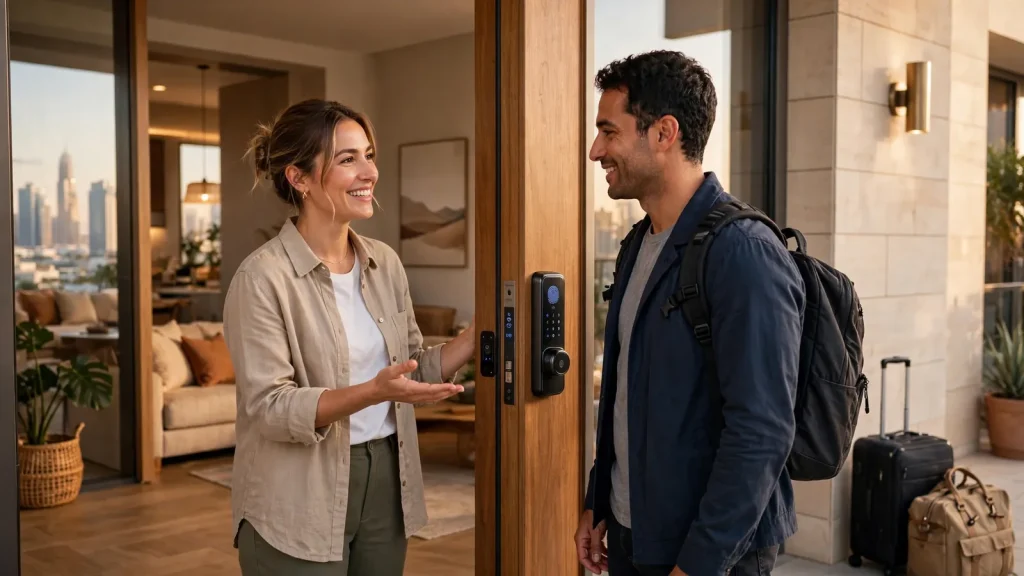
- Smart access: SIRA-integrated smart locks are mandated for eligible homes, replacing key handovers and feeding the guest-registration flow.
The standards are the floor, not the target. A failed inspection means a unit that stops earning until it passes.

Guest Registration: The Duty That Catches Operators Out
Every guest in a licensed holiday home must be registered through the DET system with valid identification captured and submitted. Check-ins and check-outs are reported promptly, on the day the stay starts and ends. A permitted, insured, beautifully furnished unit with sloppy guest registration is still a non-compliant unit.
Two practical realities: some communities layer their own guest-registration portal on top of the DET system, so the same guest gets entered twice; budget staff time for it. And the records live at unit level: revenue, Tourism Dirham collected, and who was in which unit on which night, producible on demand.
The screening layer sits beside the registration duty:
how professional guest screening works in Dubai
The Building Permission Problem
A DET permit does not override the owners’ association rules or the terms of a head lease. Some buildings and communities prohibit short-term letting outright. Check the building’s position before you sign a head-lease, before you buy, before you furnish. If a management agreement is already signed, confirm the permit eligibility of the exact unit before the first booking.
Buying a unit specifically for holiday letting: our guide to the
best areas to invest in Airbnb in Dubai
Ejari, VAT and Corporate Tax: The Lines Owners Mix Up
These three get mixed up constantly. They are separate systems:
- Ejari: Your guest stays are NOT Ejari tenancies; a licensed holiday home stay is registered through the DET system. Your own head-lease as an operator IS a normal Dubai tenancy and follows normal tenancy-registration rules. Flip a unit back to long-term and you are back in Ejari territory.
- VAT: 5% on short-term accommodation once taxable turnover passes AED 375,000 over a 12-month period. Take tax advice before you are near it, not after.
- Corporate tax: 9% on taxable income above AED 375,000 for companies; individual hosts with real-estate-investment income are generally outside corporate tax scope unless their business turnover crosses the higher threshold. This is reported by setup consultants, not settled on the portal; confirm with a tax adviser.
- One record system: Permit status and expiry, who was in which unit on which night, what was collected and what is owed to DET this month, what each owner earned. At scale this stops being diligence and becomes a data problem.
Fines and What Unlicensed Operation Really Costs
The penalties are the reason the setup order matters.
- Unlicensed letting: Fines in the AED 5,000 to 20,000 range per violation, with listings subject to removal. The rules apply across Dubai including free zones and special development zones.
- No insurance: Operating without the mandatory policy is a listed violation carrying its own fine.
- Guest-registration failures: Enforced even against otherwise compliant operators; the sector’s most actively policed duty.
- House rules: No parties, quiet hours, restricted visitor access; violations land as fines, and the permit can be suspended.
Dubai is formalising every category of accommodation at the same time: permits per unit, real records, real accountability. The shared-housing rules are a different regime (bed spaces and partitions); a holiday home permit cannot be used to run bed-space letting, and drifting between regimes puts you outside both.
One Unit to a Portfolio: How Compliance Scales
The obligations that feel light on one property become the business on a portfolio.
- Every unit registers on its own: The tenth unit needs registering exactly as the first did; growth is recurring admin, not a one-off.
- Operations stop being personal: Somewhere between a handful and a dozen units, check-ins, turnovers, maintenance response and guest communication need a team or a service provider. Budget for that before service quality slips.
- Owner relationships multiply: Each unit brings an owner with expectations, a statement to produce and a renewal to negotiate. Standardised agreements and reporting keep it manageable.
- Concentration risk: A portfolio weighted to one building or one guest segment is exposed to a single rule change, renovation or demand shift.
Seasonal demand swings change how you staff and price through the year: see our
holiday home seasonal strategy
And for ongoing maintenance, see our guide to
Dubai holiday home maintenance

Your Setup Fork: Do It Yourself or Launch Under Management
The consultant track ends at the licence; the operator track continues into revenue. Here is the honest fork:
| Factor | Self-setup | Under StayBetterDXB management |
|---|---|---|
| Paperwork | You run the DET portal, inspections, renewals | Registration, inspections, permits and guest registration handled end to end |
| Ongoing compliance | You track every deadline and file Tourism Dirham monthly | Renewals, guest records and remittances run as a managed calendar |
| Records | Your own system from day one | Unit-level revenue and owner reporting built in |
| Cost | Your time plus the government fees above | 15 to 24% of revenue all-inclusive, zero maintenance markups |
Compare the options: our owner guide to choosing a
short-term property management company in Dubai
And for what comes after the setup is live: how to
maximize your Airbnb income in Dubai
For the other half of starting:
how to start an Airbnb business in Dubai
covers the platform launch side (listing, pricing, first 30 days).
FAQs
Do I need a license to run a holiday home business in Dubai?
Yes. Holiday homes are a licensed tourism activity regulated by the Dubai Department of Economy and Tourism. Every unit must be registered, meet safety and quality standards, and follow guest-registration and Tourism Dirham rules. Operating without a permit risks fines and removal of the listing.
How much does it cost to register a holiday home in Dubai?
The operator registration is around AED 1,520 one time, and the annual unit permit is around AED 370, 670 or 970 depending on bedroom count. The Tourism Dirham (AED 10 Standard or 15 Deluxe per occupied bedroom per night) is collected from guests, not paid by you. Company formation costs apply only on the operator track.
How many units can an individual operate without a company?
The commonly cited ceiling is around eight units under an individual setup, with a permit registered per unit. Beyond that, or if you manage units for other owners, a licensed company with a trade licence carrying the Vacation Homes Rental activity is required. Confirm the current threshold on the DET portal, as it has moved before.
Can a tenant operate a holiday home in Dubai?
Yes, with written permission from the landlord. A tenant needs the owner’s No Objection Certificate and must register the unit with DET like any operator. Without written authorisation, the setup is not legal.
How long does DET approval take?
With complete documents, operator registration and unit-permit approval are typically measured in working days; the full company route (formation plus registration plus permits) realistically runs from a few working days to around two weeks. Assemble your documents before you apply: incomplete applications are what take months.
What is the Tourism Dirham and who pays it?
The Tourism Dirham is a government charge on paid accommodation that the operator collects from guests and remits monthly: AED 10 per occupied bedroom per night for Standard units, AED 15 for Deluxe. It is a pass-through, not an operator cost, and it is separate from VAT.
What happens if I operate without a permit?
Unlicensed short-term letting is an enforcement matter: fines in the AED 5,000 to 20,000 range per violation, plus removal of the listing. Since listings are public, unlicensed operation is easy to spot, so the permit should be in place before the first booking.
Can I manage holiday homes for other owners under my own license?
No, not under an individual setup. Managing other people’s units is the licensed-operator track: a company with a trade licence carrying the Vacation Homes Rental activity, registration as a Holiday Home Operator with DET, a permit for every unit, and a written management letter for each owner relationship.