Checkout time has passed, the next guest is on the way, and the keys have not come back. This guide gives owners the exact order to follow when a Dubai holiday home guest stays past checkout, so a bad day does not become a lost week.
- First move: Message the guest in writing, protect the next booking, and gather your documents before you argue about anything.
- The route: A short-stay guest overstay goes through the tourism authority dispute process, not through the long-term tenant eviction process.
- Never do this: Do not change the locks, remove belongings, or cut utilities to force a guest out.
- The cost: Every blocked night is a night you cannot sell again, so speed and paperwork matter more than anger.

Late Checkout, Overstay, or Tenant Holdover: Which One Is This
Three situations look alike at the door, but each one follows a different route. Naming yours first keeps you from using the wrong process.
| Situation | What it really is | Which route applies |
| Late checkout | Guest leaves hours after checkout time, still on the same day | House rules and the late-checkout charge in your terms. |
| Overstay | Guest stays past the agreed checkout date and will not leave | Tourism authority dispute process for holiday home guests. |
| Tenant holdover | Long-term tenant stays after a tenancy contract ends | Long-term tenancy dispute process, a different regime entirely. |
If your guest booked nights, paid nightly, and checked in as a holiday home guest, you are in row two. Do not borrow row three procedures for a row two problem.
The First Hour: What to Do in Order
Work this list top to bottom. Each step protects the next one.
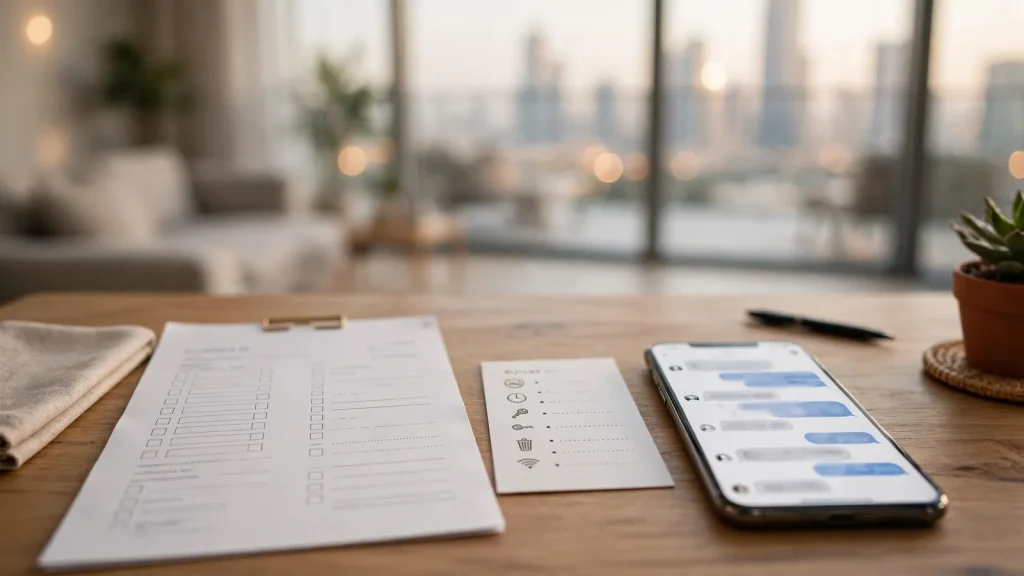
- Message in writing: Send one calm written message stating the checkout time, the agreed stay dates, and that the stay has ended. Keep every reply.
- Protect the next booking: Contact the incoming guest early, explain a delay without blaming anyone, and offer a clear plan.
- Gather your documents: Pull the booking record, the guest check-in document, the house rules, and the message thread into one folder.
- Record the stay: Make sure the check-in and check-out record matches reality on the holiday homes system.
- Offer a paid extension in writing: If you are willing to sell extra nights, put the price and the new checkout time in writing first.
- Escalate through the right channel: If the guest still will not leave, start the dispute route in the next section.
What Not to Do, Even When It Feels Justified
Self-help feels fast and usually makes the case worse. It can turn a clear overstay into a dispute about your own actions.
- Locks: Do not change the locks or deactivate access to force a guest out.
- Belongings: Do not remove or hold a guest belongings as leverage.
- Utilities: Do not cut power, water, or internet to the unit.
- Confrontation: Do not enter the unit to argue in person when messages will do the job.
- Threats: Do not threaten fines or penalties you cannot show in your own terms.
The DET Dispute Route, Step by Step
The tourism authority runs a dispute process for holiday home guests. This is the published order of that process, written for owners.
This guide explains the published procedure in plain language. It is not legal advice. For a contested case, take professional advice before acting.
| Step | What happens | What you file |
| File the complaint | Submit the dispute to the tourism authority disputes office with full details | Booking record, guest check-in document, house rules, message thread. |
| Meeting set | A meeting is set with both parties to review documents and statements | Your timeline of the stay, checkout time, and every written exchange. |
| Peaceful resolution first | The authority seeks an amicable solution and sets a resolution period | Any offer you made in writing, and the guest reply. |
| Decision issued | The authority decides after receiving documents and hearing both parties | Nothing new at this stage, unless the authority asks for it. |
| Written notice | If the authority finds for the licensee, a written eviction notice goes to the guest | Keep the notice with your booking file. |
| Final step only | If the guest still fails to leave after that notice, security-authority assistance may be sought | The written notice and the decision. |
- If the guest wins: If the authority finds the guest has the right to remain, written notice goes to the licensee to adhere to the decision.
- If a party rejects the solution: If a party does not accept the amicable solution offered, the complaint is closed and the parties are directed to the judicial authorities if required.
- If a party goes silent: If either party fails to respond to authority letters beyond five business days, the authority decides the complaint automatically.
Notice what this route rewards. It rewards the owner with clean documents, a written timeline, and a calm message thread. It punishes improvisation.
Use the tourism authority dispute process for a holiday home guest case.
For the full compliance rulebook, see the Dubai Airbnb rules guide.
Your Channel Changes the First Call
The dispute route stays the same, but your first call depends on where the booking came from. Use this table before you call anyone.
| Booking channel | First call | Evidence to attach |
| Airbnb booking | Platform support for that booking, plus the dispute route for the licence | Booking record, message thread, checkout terms. |
| Direct booking | Your own written notice, then the dispute route | Guest check-in document, house rules, payment record. |
| Other platform booking | That platform support, then the dispute route | Booking record, platform messages, checkout terms. |
A platform can move a booking, refund a night, or close a calendar. Only the tourism authority route decides a holiday home guest dispute under the licence. Keep both tracks running and keep their paperwork separate.
What an Overstay Really Costs
Owners usually count the lost night and miss the rest. This worked example shows the full shape of the loss. Every figure here is illustrative, not a market rate, and your own numbers will differ.
| Cost item | Illustrative amount | Why it happens |
| Blocked nights | AED 1,650 | Three lost nights at an illustrative AED 550 per night. |
| Cleaning rescheduled | AED 250 | Crew booked, then moved, then booked again. |
| Next guest goodwill | AED 300 | Apology gesture or rebooking help for the displaced guest. |
| Total illustrative exposure | AED 2,200 | Three nights of loss plus two knock-on costs. |
The math is deliberately simple. Three blocked nights already outweigh the cost of a proper check-in document, a smart-lock code that expires on time, and a calendar buffer between stays. Prevention is priced in the next section.
Extra Nights, Deposits, and the Tourism Dirham on Overstay Nights
Money questions cause most overstay arguments. Settle these three before the next booking, not during it.
- Extra nights: A late checkout after the standard checkout time may incur a full unit rate under the published example. A partial rate does not carry the same treatment.
- Tourism Dirham: The fee follows physical occupancy. It applies per occupied bedroom per night, at the standard or deluxe rate for the unit, for the first thirty consecutive nights of a stay.
- Deposits: Where a security deposit was taken and the guest was advised that non-compliance may result in charges against it, those charges must be handled, accounted for, and the balance released as soon as possible after departure.
- Extension first: A paid extension agreed in writing before checkout beats an argued extra night after checkout every time.
Permit costs sit behind every licensed stay. Read the holiday home licence cost in Dubai to plan for them.

The Prevention System That Makes This Rare
The best overstay playbook is the one you never open. Build these five habits into every stay.
- Checkout in writing: Checkout time sits in the booking, the check-in document, and the house rules, all three.
- Extension deadline: Guests must request an extension within a reasonable time before expiry, not after it.
- Smart-lock codes: Access codes expire at checkout time, not at some later hour you forgot to set.
- Calendar buffer: Leave a buffer between stays so one late departure cannot break the next arrival.
- Screening link: Strong vetting before arrival filters out most problem stays before they start. Read how to screen short-term rental guests in Dubai.
Guest Eviction Is Not Tenant Eviction
This confusion costs owners months. A holiday home guest and a long-term tenant live under different regimes, and the wrong route wastes both.
| Question | Holiday home guest | Long-term tenant |
| Route | Tourism authority dispute process | Long-term tenancy dispute process. |
| Notice style | Written eviction notice after an authority decision | Formal tenancy notice with its own long notice period. |
| Timeline shape | Complaint, meeting, decision, notice | Notice period, filing, hearing, enforcement. |
If your occupant signed a tenancy contract and pays monthly rent, stop here and read how to convert a tenanted apartment to Airbnb in Dubai instead. Mixing the two routes is the single most expensive mistake in this area.

When to Hand the Whole Problem to a Manager
An overstay is also a test of your operation. If you manage from abroad, juggle several units, or simply cannot take the calls, this is the work a manager exists to carry.
- One owner of the problem: A manager takes the messages, the documents, and the dispute filing, so you do not learn the procedure mid-crisis.
- Systems before emergencies: Check-in documents, expiring codes, calendar buffers, and deposit handling run the same way on every stay.
- A Superhost operation behind it: StayBetterDXB runs Dubai holiday homes as a Superhost-operated team, with live listings, guest messaging, and turnover handled under one roof.
The management question is simple. Do you want to be the person arguing about checkout time, or the owner who gets a clean report when it is over? See the short-term property management company in Dubai for the full management model, fees, and services. Compare property management companies in Dubai and management packages and pricing to find the right fit.
Is a guest overstay the same as a tenant refusing to leave?
No. A holiday home guest follows the tourism authority dispute route. A long-term tenant follows the tenancy dispute route. Using the wrong route wastes time and weakens your case.
Can I change the locks when a guest overstays?
No. Do not change locks, remove belongings, or cut utilities to force a guest out. Work the written notice and dispute route instead, and keep every message.
How long does the tourism authority dispute process take?
The authority sets a resolution period for each case, so no fixed timeline can be promised. One firm rule is published: if either party fails to respond to authority letters beyond five business days, the authority decides the complaint automatically.
Do I still collect the Tourism Dirham on overstay nights?
The fee follows physical occupancy, per occupied bedroom per night, for the first thirty consecutive nights of a stay. A full-rate extra night carries it. A partial rate does not.
Can I charge the guest for extra nights after checkout?
A late checkout after the standard checkout time may incur a full unit rate under the published example. Agreeing a paid extension in writing before checkout is cleaner than arguing the charge after it.
What if the guest booked through Airbnb?
Contact platform support for that booking first, and run the dispute route for the licence in parallel. Keep platform messages and licence paperwork in separate folders.
What if the guest claims they paid for a longer stay?
Documents decide. The booking record, the guest check-in document, and the written message thread show the agreed dates. That is why the first-hour document folder matters.
Should I call the authorities immediately?
No. Security-authority assistance is the final step, sought only if the guest still fails to leave after a written eviction notice from the authority. Start with written notice and the dispute filing.