
Renting in Dubai is not like renting anywhere else: you pay the whole year in advance with post-dated cheques, a government index decides whether your landlord can raise the rent, and an eviction needs a full year’s notice served through a notary. This guide walks you through the money rules, the paperwork, your rights, and the scams to dodge, so you sign your lease with total confidence. If you want the move-in steps too, read our guide on how to rent an apartment in dubai.
- Deposit: 5% of annual rent for unfurnished units, 10% for furnished, refundable at move-out.
- Agency commission: 5% of the first year’s rent plus VAT, usually paid by the tenant, negotiable.
- Cheques: Leases run a year and rent is paid in post-dated cheques; 1, 2, or 4 is the common spread.
- Ejari and DEWA: Tenancy registration costs about 178 online or 220 in person; DEWA deposit is 2,000 for apartments.
- Rent increases: Capped by the Smart Rental Index; any increase needs written notice at least 90 days before renewal.
- Evictions: A landlord needs a 12-month written notice served through a notary for one of four legal reasons only.
How the Money Works in Dubai Rentals
In Dubai, renting starts with money, not paperwork. The lease is annual and paid upfront in post-dated cheques, and three separate payments stack on top of the first cheque. Knowing each one before you start viewing keeps you from getting surprised at the signing table.
- Security deposit: 5% of the annual rent for unfurnished apartments, 10% for furnished. It is refundable, but refunds are fought and won with evidence: photograph every wall, floor, and appliance at move-in and keep the dated photos. See how security deposits work.
- Agency commission: The convention is 5% of the first year’s rent plus VAT, usually paid by the tenant. It is negotiable, and you should never hand it over in cash without a signed receipt.
- Rent cheques: Your rent comes as 1, 2, or 4 post-dated cheques, with 4 the common middle ground. Fewer cheques sometimes buy a discount, but a single cheque is only worth accepting if the discount is real and in writing. Some buildings also offer monthly payment options.
| Cost | Typical amount | Refundable |
|---|---|---|
| First rent payment | Largest single payment | No, rent due. |
| Security deposit | 5% unfurnished, 10% furnished | Yes. |
| Agency commission | 5% of annual rent plus VAT | No. |
| DEWA deposit | 2,000 for apartments | Yes. |
| Ejari registration | About 178 online, 220 in person | No. |
Your day-one outlay lands well above the first rent payment, so budget beyond the headline rent. As a rule of thumb, keep rent around 30 to 35% of your net monthly income, and most affordable areas to rent. Units that have sat empty through the summer months are your best leverage for a deal.

The Paperwork That Makes It Legal
Dubai protects tenants through registration, not handshakes. Three systems make your tenancy legal and livable.
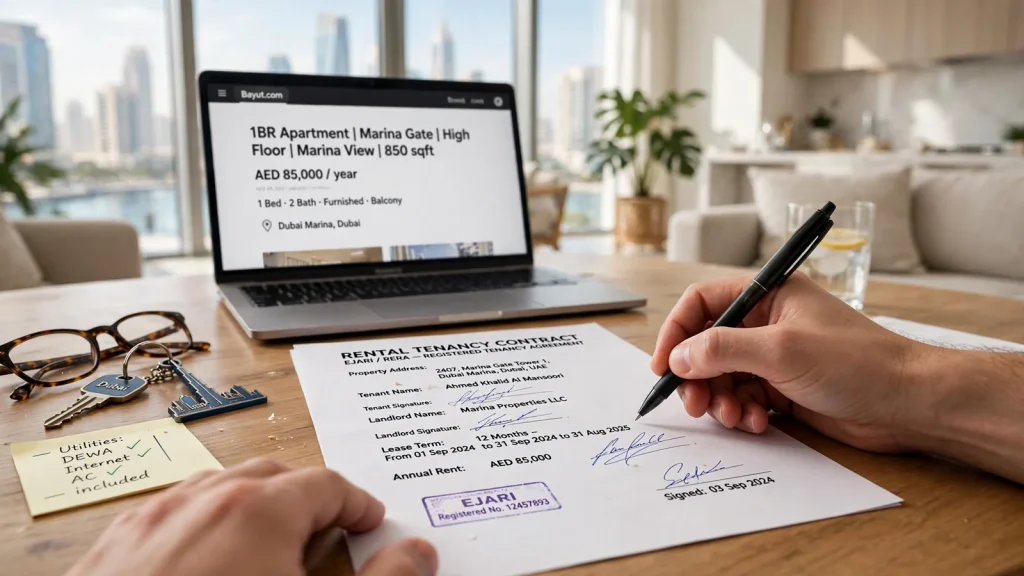
- Ejari: The Dubai Land Department’s online tenancy-registration system. Registration is not optional: without it you cannot connect DEWA, set up home internet, or process a residence visa. It costs about 178 online or 220 at a trustee centre. The landlord is legally responsible for registering, but in practice the tenant usually arranges and pays for it, so agree who does it before you sign.
- DEWA: After Ejari, set up water and electricity in your name. The deposit is 2,000 for apartments, and the tenant pays it as standard. A municipality housing charge is also added to the utility bill each month, so your DEWA bill is not just for water and power.
- Unified tenancy contract: Read every clause before signing: the early-termination penalty, who handles maintenance up to what amount, the rent-increase clause, and the subletting rules. And never pay a holding amount without the payee, the purpose, the exact unit, and the refund terms all in writing.
- Documents: If you want the full paperwork list, see the documents landlords ask for.

Once the paperwork is clear, the next step is the process itself; our step-by-step renting process walks you through it.
Smart Rental Index: Your Rent-Increase Shield
This is the single most useful piece of tenant knowledge in Dubai. The Dubai Land Department’s Smart Rental Index replaced the old index with AI-enhanced building-level benchmarks, and it is the ceiling on what your landlord can charge.
- The bands: Under Decree 43 of 2013, increases are capped. No increase is allowed when your current rent is within 10% of the benchmark, and increases of up to 5, 10, 15, or 20% apply only at the deeper bands. In plain language: if your rent already meets or beats the benchmark, no increase is allowed.
- The 90-day rule: Any rent change needs written notice at least 90 days before your contract ends. Miss the window and the rent rolls over unchanged.
Check the official DLD Rental Index yourself before renewal talks. Walking in with the index numbers turns a rent fight into a paperwork exercise.
Viewing Checklist: What to Check Before Saying Yes
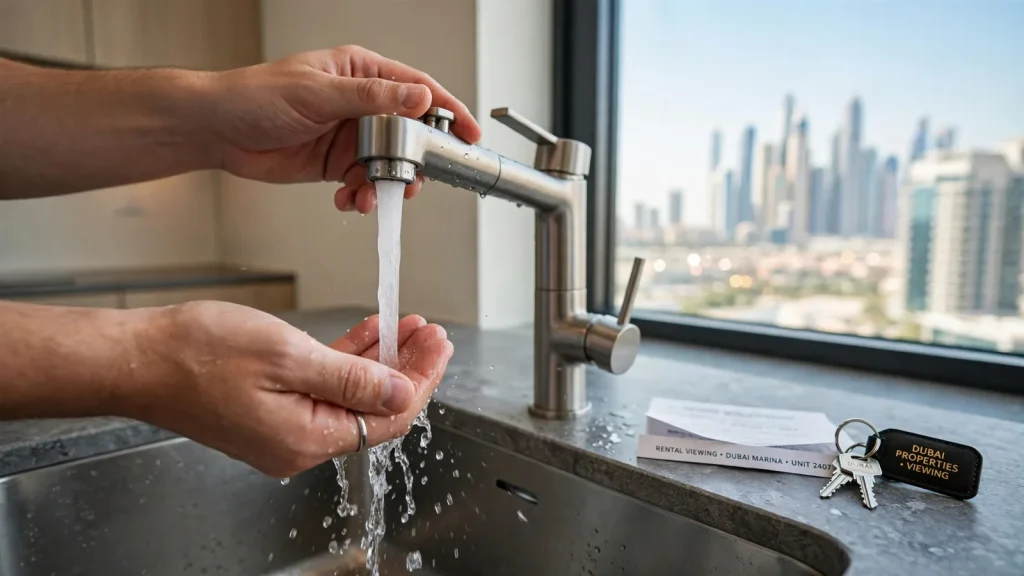
Portals show you the good angles. The viewing is where you find the rest. This condensed walkthrough covers what to test; the full list lives in our apartment viewing checklist.
- Run every tap and test shower pressure; flush every toilet; open every cabinet and look under every sink.
- Run the AC and confirm it actually cools the room.
- Test every lock, light switch, and power outlet.
- Look for damp patches and mould, especially in bathrooms and under windows.
- Visit once in the evening or on a weekend to feel the noise and the parking pressure.
- Ask the building’s residents about maintenance response times, not the agent.
- Photograph everything at move-in; those photos are your deposit defense.
Before you sign, ask “district cooling or split AC?”. District-cooling bills come separately from DEWA and can change your true monthly cost, so confirm the billing method and who pays, in writing.
Rental Scams in Dubai: Red Flags
Dubai’s rental market is well regulated, which is exactly why scammers work outside the system. The pattern is always the same: fake listings, landlord impersonation, and pressure to pay before you have seen the unit.
- Check the agent’s RERA licence on the Dubai REST app before sharing documents or money.
- View the unit in person; never transfer a deposit for a place you have not seen.
- Confirm the title deed matches the person asking for money.
- Walk away from anyone who pressures you to pay today.
For the full prevention system, read our rental scam prevention playbook.
Your Rights as a Tenant (Law 33 of 2008)
Dubai’s tenancy law is one of the most tenant-protective in the region, and knowing the two numbers that matter changes every conversation with a landlord.
- During the lease: The tenancy can only be ended by mutual consent or as the law provides (Article 7, Law 26 of 2007). Your landlord cannot ask you to leave mid-contract on a whim.
- At expiry: A landlord can end the tenancy only for four statutory reasons: the landlord or a first-degree relative wants to move in, the property is being sold, the building is being demolished, or major renovation requires the unit to be vacant. Each one needs a full 12-month written notice served through a notary public or registered mail. A WhatsApp message, an email, or the agent’s word does not count.
- Renewal protection: A lease continues on the same terms unless a valid notice lands. A rent increase outside the index bands, or one without the 90-day notice, can be challenged at the Rental Dispute Settlement Centre. And if a landlord evicts you for personal use and re-lets the unit, you can claim compensation through the RDC.
- On cheques: A bounced cheque is a civil matter, not a criminal one, so do not let anyone tell you otherwise.
Renewal Season: How to Handle It
Start 120 days before your contract ends. Run the index check, keep every notice email dated, negotiate with index proof in hand, and know your walk-away number before the conversation starts. The index math sits in the Shield section above; renewal season is about using it.
Key Takeaways
- Budget day-one outlay, not just the rent: deposit, commission, DEWA, and Ejari stack on top of the first cheque.
- Pay with cheques you understand: 1, 2, or 4 is the norm, and a single cheque only for a real, written discount.
- Register Ejari within two weeks of signing; nothing else in your move works without it.
- Check the Smart Rental Index before any renewal talk, and demand the 90-day written notice.
- View twice if you can: once by day, once in the evening, and photograph everything.
- Verify every agent’s RERA licence on the Dubai REST app, and never pay for a unit you have not seen.
- Know the 12-month notary notice rule; it is the strongest right you have.
If you are relocating and need a furnished base while you view apartments, our Superhost-managed monthly stays keep you close to the action. Message us on WhatsApp and we will match a home to your viewing calendar.
Frequently Asked Questions
How much money do I need upfront to rent an apartment in Dubai?
First cheque plus security deposit (5% unfurnished, 10% furnished), agency commission (5% of annual rent plus VAT), DEWA deposit (2,000 for apartments), and Ejari (about 178 online or 220 in person). Plan well beyond the first rent payment.
Is rent paid monthly or yearly in Dubai?
Yearly leases paid in post-dated cheques, most commonly 1, 2, or 4. More cheques is a common standard and negotiable. Some buildings also offer monthly payment options.
What is Ejari and why does it matter?
The Dubai Land Department’s tenancy-registration system. You need it to connect DEWA, get home internet, and process residence visas. Get it registered within two weeks of signing.
How much is the agency commission when renting in Dubai?
The convention is 5% of the first year’s rent plus VAT, usually paid by the tenant, and it is negotiable. Always get a receipt.
Can my landlord increase my rent at renewal?
Only within the Smart Rental Index bands (Decree 43 of 2013) and only with written notice at least 90 days before expiry. If the rent already meets the index benchmark, no increase is allowed.
How do I avoid rental scams in Dubai?
Check the agent’s RERA licence on the Dubai REST app, view the unit in person before paying anything, confirm the title deed matches the person asking for money, and never pay a holding deposit without the terms in writing.
Can a landlord evict me in Dubai?
During the lease, only by mutual agreement or per the law. At expiry, only for four statutory reasons (personal or family use, sale, demolition, major renovation), each requiring a full 12-month notice served through a notary public or registered mail.
What should I check when viewing an apartment in Dubai?
Water pressure, AC cooling, plumbing, locks and outlets, signs of damp, an evening or weekend visit for noise and parking, and the cooling-billing method (district cooling vs split AC) before you sign.